
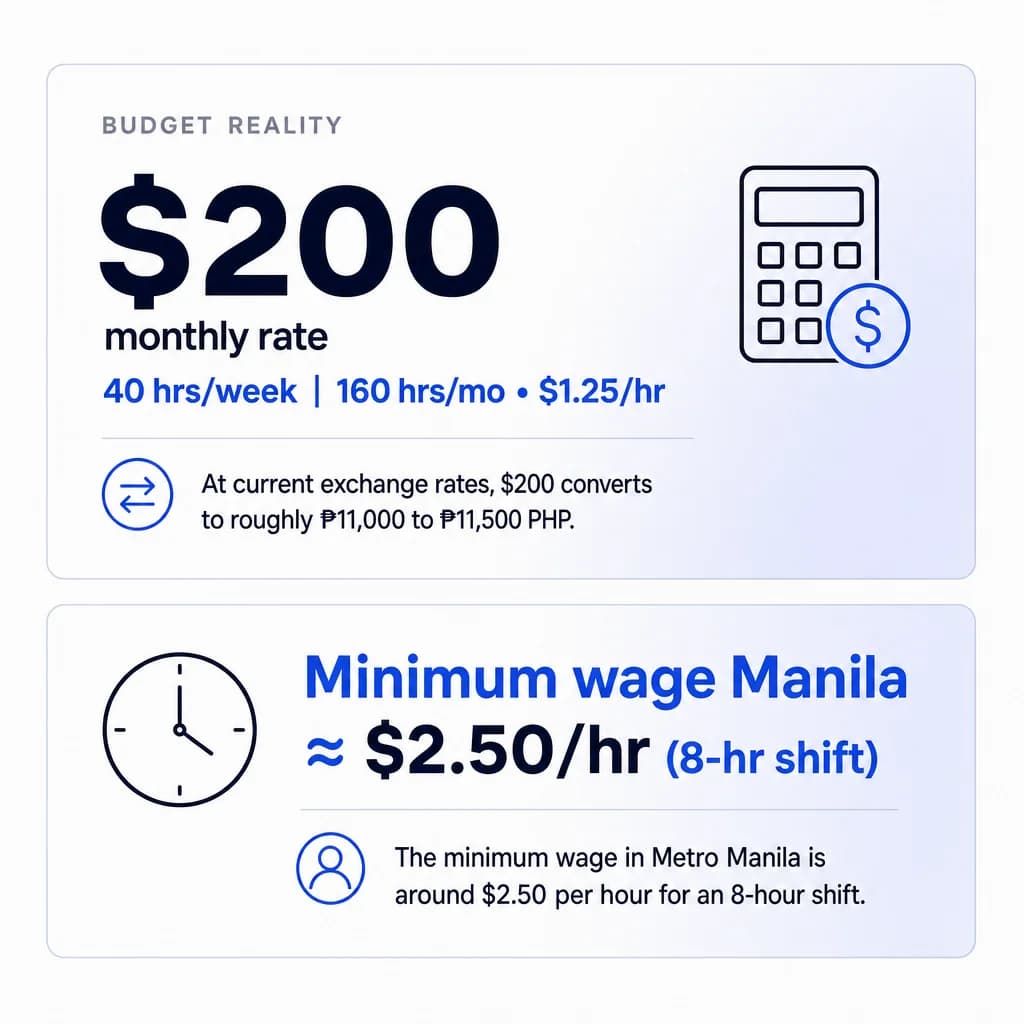
At current exchange rates, $200 converts to roughly ₱11,000 to ₱11,500 PHP.
Here’s where it gets interesting. If you’re expecting full-time work (40 hours per week, 160 hours per month), you’re paying about $1.25 per hour.
The minimum wage in Metro Manila is around $2.50 per hour for an 8-hour shift.
You’re already below minimum wage.
Are You Looking to Hire in the Philippines and Unsure Where to Start?
Sign up for an account and recruit your next employee within minutes!
Get StartedWhat You’re Actually Buying
Most employers at this budget aren’t actually hiring full-time. They’re getting 20 to 40 hours per month—that’s 5 to 10 hours per week.
At 20 hours monthly: $10 per hour
At 40 hours monthly: $5 per hour
This is entry-level territory. Part-time. Beginner work only.
Tasks That Fit This Budget
Let me break down what $200 actually buys you in terms of tasks.
Basic Data Entry. Someone who can copy and paste information into spreadsheets, file documents, and sort through lists. One job posting I saw offered exactly $200, non-negotiable, for this type of work.
Basic Email Management. Template-based replies to basic customer inquiries. Nothing that requires thinking or problem-solving. Just “Thank you for your message, here’s the answer to your question” type stuff.
Basic scheduling and light research. Booking appointments, Googling information and compiling it into a list, and making sure your meetings don’t overlap.
What’s Off the Table at $200
Here’s what you don’t get at $200:
Ecommerce management: starts at $800
SEO or content writing: $600 to $700
Graphic design: $800
Real customer service with sales or troubleshooting: $600 minimum
Social media management beyond posting: $600+
Skilled workers reject these rates outright. They know their worth.
Task Type | Hours You’ll Get Per Month | What It Actually Looks Like |
|---|---|---|
Data Entry | 30-40 hours | Copy-paste work, basic spreadsheets, simple filing |
Email/Scheduling | 20-30 hours | Template responses, calendar management |
Basic Research | 10-20 hours | Google searches, list compilation |
Anything Specialized | 0 hours | You need $400+ for this |
Who Actually Applies at This Rate
Beginners.
People with limited or no remote work experience who need to build a portfolio. Students. People in provinces where the cost of living is lower than Manila.
You’ll get applications. Lots of them, actually. But you’re not getting the cream of the crop.
What You’re Missing
The experienced workers are on platforms looking for $500, $800, $1,200 monthly rates. They have options. They’ve already proven themselves.
At $200, you’re getting someone who needs training.
Heavy training. Expect to spend one to two weeks just getting them up to speed on your systems.
Their English might be rated 7 or 8 out of 10 by their own assessment, which usually means 6 or 7 in reality.
The Turnover Problem
You’re also getting high turnover risk. The moment someone offers them $300 or $400, they’re gone. Can you blame them?
The average salary for an office worker in Manila is around $525 per month. That’s what you’re competing against for anyone with real skills and experience.

The Upside (Yes, There Is One Probably)
This isn’t all doom and gloom.
$200 can work as a testing ground. You’re trying out remote work for the first time? Start here.
See if you can manage someone remotely. Figure out your systems. Learn what tasks you can actually delegate.
Post a job at this rate and you’ll have 50 to 100 applications within days. That’s a lot of people to choose from, even if the overall quality is lower (way lower).
The Long-Term Play
If you’re willing to invest in training someone, you can build loyalty. Some employers have taken $200/month beginners and turned them into $500/month reliable team members.
But that takes effort on your part.
The Reality Check Nobody Wants to Hear
Most people offering $200 are hoping for $600 worth of work. They want someone experienced, skilled, self-directed, and full-time.
That’s not how this works.
The Market Reaction
When influencers or small business owners post jobs at $175 to $200 monthly, Filipino remote workers call it out publicly.
They share these job posts in communities and talk about how insulting the rates are. It’s not just that they won’t apply, they actively warn others away from these opportunities.
The Competition You’re Facing
You’re not just competing with other international employers. You’re competing with local Philippine companies, BPOs (business process outsourcing firms), and other remote employers who pay better.
The training burden is real. These aren’t people who can start on day one and run with minimal supervision. You’ll need clear processes, documented procedures, regular check-ins, and patience.
What It Costs to Actually Hire
Beyond the Salary
The $200 isn’t your only cost.
Upwork and Fiverr take 20% or more from the worker’s pay, which means your $200 becomes $160 in their pocket. That makes the rate even less attractive to quality candidates.
Tools and software:
Time tracking software: $10 to $20 per month
Project management tools: Free to $15 per month
Communication tools: Usually free (Slack, Google Meet)
Payment processing: Wise charges around 1% to send money to the Philippines. PayPal is higher.
Your Time Investment
Your time is a cost. Interviewing candidates, training them, managing them. If you’re a business owner billing at $100/hour and you spend 10 hours on this, that’s $1,000 of your time.
When $200 Makes Sense vs. When It Doesn’t
It Makes Sense When:
You need very basic, clearly defined tasks done
You have time to train someone
You’re testing remote work for the first time
You’re a solopreneur with a tight budget
You’re okay with part-time help
It Doesn’t Make Sense When:
You need someone to hit the ground running
You need specialized skills
You need full-time work
You can’t afford turnover
You don’t have time to train and manage closely
You need someone who can think independently and solve problems
The Comparison to Higher Budgets
Here’s what happens when you increase the budget:
At $600 to $800: You’re getting specialized skills — SEO specialists, graphic designers, experienced customer service reps who can handle sales, and content writers. People who transform your business instead of just supporting it.
At $1,000+: You’re getting senior-level talent. People who can manage others. Specialists with years of experience. Workers who could command good salaries in local Philippine companies but choose remote work for the flexibility.
The US Comparison
Compare that to US-based workers at $3,000+ monthly for similar work, and you see why people hire from the Philippines. But you can’t expect US-level work at $200.
The Platform Difference
How Platform Choice Affects Results
Where you hire matters as much as how much you pay.
DIY platforms let you post jobs and handle everything yourself. You interview, you negotiate, you set up payment. Lower fees, but more work.
Full-service recruiters do the recruiting for you. They pre-screen candidates, do background checks, and handle contracts. Higher fees (typically $500+), but less hassle.
Hybrid solutions like HireTalent.ph handle basic compliance while giving you direct access to a pool of pre-vetted candidates, which matters when you’re working with a tight budget and need to find someone trainable.
Stories from Employers
The Quick Exit
One employer hired someone at $200 for data entry. A months in, the worker found a $400/month job and left with one week’s notice. The employer had just finished training them.
The Success Story
Another employer started someone at $200 for 15 hours a month, invested heavily in training, and after three months increased them to $460 for full-time work. That person has been with them for two years now.
The Disappearing Act
A third employer posted a job at $200 and got 200 applications in two days. They spent a week interviewing and hired someone who seemed great. Two weeks in, the person disappeared—stopped responding to messages and never showed up again.
The Pattern
$200 works when you see it as an investment in finding and training someone, with plans to increase their pay as they prove themselves. It fails when you expect too much too soon or when you’re not prepared for turnover.
The Bottom Line
$200 a month gets you 20 to 40 hours of entry-level, basic administrative work from someone who needs training and might leave for a better offer.
It doesn’t get you a skilled, experienced, full-time remote worker who can operate independently.
If that’s all your budget allows, go in with eyes open. Plan to train. Plan for possible turnover. Start with very simple, clearly defined tasks. Consider it a trial task first.
If you can stretch to $600 to $800, you’ll have a dramatically better experience: more applications from experienced workers, less training needed, better retention, and more actual value delivered.
The Philippines has incredible remote talent. But like anywhere else in the world, you get what you pay for.